
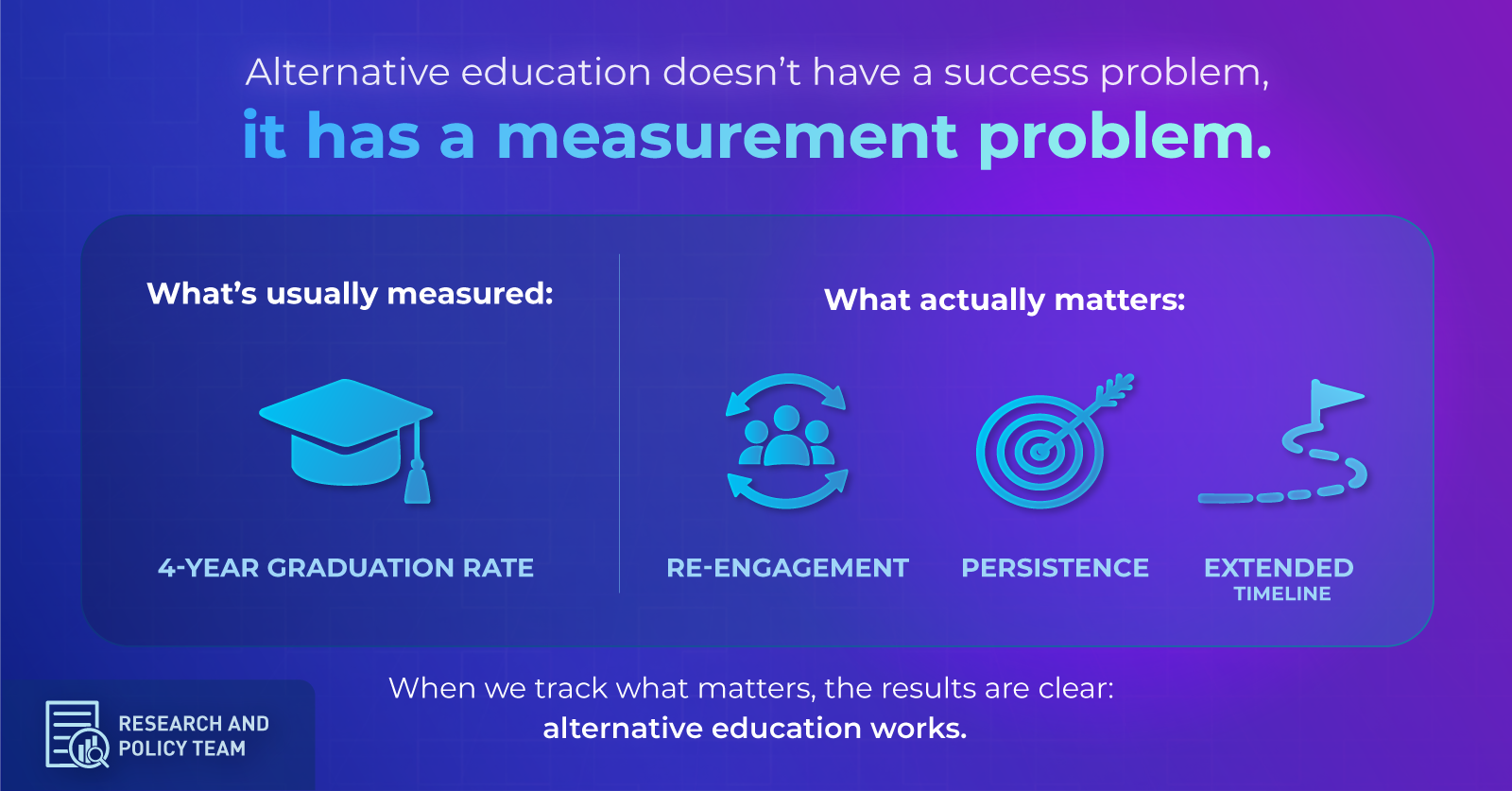
Why Traditional Metrics Miss the Success Stories
If you judge alternative education programs solely by four-year graduation rates, you’ll miss the most important story: thousands of students who were on track to drop out permanently are instead earning diplomas and credentials.
The Measurement Problem
Here’s the challenge: Alternative education programs typically serve students who are deeply off-track — often years behind in credits, chronically absent, or already officially dropped out. These students enter alternative programs with a near-zero probability of graduating on the traditional timeline.
When you start with students who were unlikely to graduate at all, a 39% four-year graduation rate isn’t failure, it’s remarkable progress. Especially when that number climbs to 52% when you measure seven-year graduation rates, as Colorado discovered.
What the Numbers Really Tell Us
Nationwide, nearly 68% of alternative high schools have four-year graduation rates below 60%. Compare that to just 6% of regular high schools falling below that threshold. On the surface, this looks damning.
But consider the alternative: What would happen to these students if alternative education programs didn’t exist?
The evidence strongly suggests most would simply drop out and never return. In that context, alternative education isn’t just effective, it’s essential.
The Metrics That Matter: Re-Engagement and Persistence
The more meaningful question isn’t “Do these students graduate in four years?” It’s “Do students who were disconnected from education re-engage and persist toward completion?”
On this measure, alternative education shows impressive results:
National League of Cities Reengagement Network data (covering 20 cities) found:
- 11,737 previously disconnected students earned diplomas or equivalents in a single year
- 69.8% of re-enrolled students remained enrolled or completed credentials by year-end
- This represents a nearly 70% “stick rate” for a population that was, by definition, on the verge of being permanently lost
Think about that: Seven out of ten students who had already disconnected from education stayed connected when given an alternative pathway. That’s not a failure rate, that’s a success story.
Extended Pathways Work
States are increasingly recognizing that alternative schools need different accountability measures. Many now track:
- 5-year, 6-year, and 7-year graduation rates
- GED and equivalency credential attainment
- Credit accumulation and grade-level progression
- Successful transitions to employment or postsecondary education
- College and career readiness benchmarks
Colorado’s experience is instructive: The state’s alternative schools showed a 39% four-year graduation rate, but when given three additional years, that figure jumped to 52%. That’s thousands of additional students earning credentials they wouldn’t have otherwise.
The Counterfactual Question
To truly assess alternative education’s impact, we must ask: What’s the alternative?
For most students in alternative programs:
- Traditional schools have already failed to engage them
- They’ve experienced chronic absenteeism, discipline issues, or credit deficiency
- Many have formally withdrawn or simply stopped showing up
- Without intervention, their probability of graduating is essentially zero
Against this baseline, alternative education programs represent:
- A pathway where none existed
- Support systems specifically designed for disengaged students
- Flexibility that accommodates real-life circumstances
- Individualized attention traditional schools can’t provide
Program Design Makes the Difference
Not all alternative education programs produce strong results.
The most effective programs share common elements:
Personalization:
- Small class sizes and low student-to-teacher ratios
- Individualized learning plans
- Competency-based progression
Flexibility:
- Alternative schedules (evening, weekend, year-round)
- Online and hybrid options
- Self-paced credit recovery
Wrap-Around Services:
- Mental health counseling
- Case management
- Transportation assistance
- Childcare support
- Career coaching
Engagement Strategies:
- Relevant, real-world curriculum
- Strong student-teacher relationships
- Mentoring programs
- Community connections
When alternative programs incorporate these elements, they consistently help students who were far off track reach graduation or credential attainment.
The Fiscal Reality
Alternative education is also cost-effective. States already fund these students through traditional per-pupil funding. The question isn’t whether to spend money on them — they’re already in the system. The question is whether to invest in programs designed for their needs.
The return on investment is clear: Re-engaging a student who would otherwise drop out generates approximately $345,000 in lifetime tax revenues and reduced social costs. The cost of alternative education programming represents a tiny fraction of this return.
A Call for Appropriate Accountability
The education community increasingly recognizes that holding alternative schools to traditional graduation timeline metrics is counterproductive.
Instead, accountability systems should measure:
- Access: Are we successfully identifying and recruiting disconnected students?
- Engagement: Do students who enroll remain actively engaged?
- Progress: Are students accumulating credits and advancing toward graduation?
- Completion: What percentage ultimately earn diplomas or credentials (on any timeline)?
- Transition: Do graduates successfully transition to employment or postsecondary education?
Many states have already adjusted accountability frameworks accordingly, recognizing that alternative schools serve fundamentally different student populations with different needs and timelines.
The Bottom Line
Alternative education programs are critical dropout safety nets. When well-implemented, they demonstrate remarkable ability to retain and graduate students who would otherwise become permanent dropouts.
The evidence is clear: These programs work. But we’ll only see their full potential when we measure what matters — not whether students finish in four years, but whether they finish at all.
The reality: Alternative education doesn’t have a success problem, it has a measurement problem. When we track extended graduation rates, re-engagement, and persistence, we see thousands of young people reclaiming their education and their futures.
This is the fourth part in a series exploring the economic and social benefits of re-engaging high school dropouts.
The Acceleration Academies’ Research & Policy Team is dedicated to advancing data-driven insights that help schools and communities better support opportunity for youth. Our team focuses on shining a light on barriers faced by students who have been disengaged from traditional high school pathways, elevating actionable data that helps schools re-engage learners, and driving evidence-based solutions for students who have been left behind.