
The numbers sound encouraging at first: America’s high school graduation rate reached 86% in 2019, the highest in decades. But behind that headline figure lies a persistent crisis that costs our economy billions and derails over a million young lives each year.
The 26-Second Problem
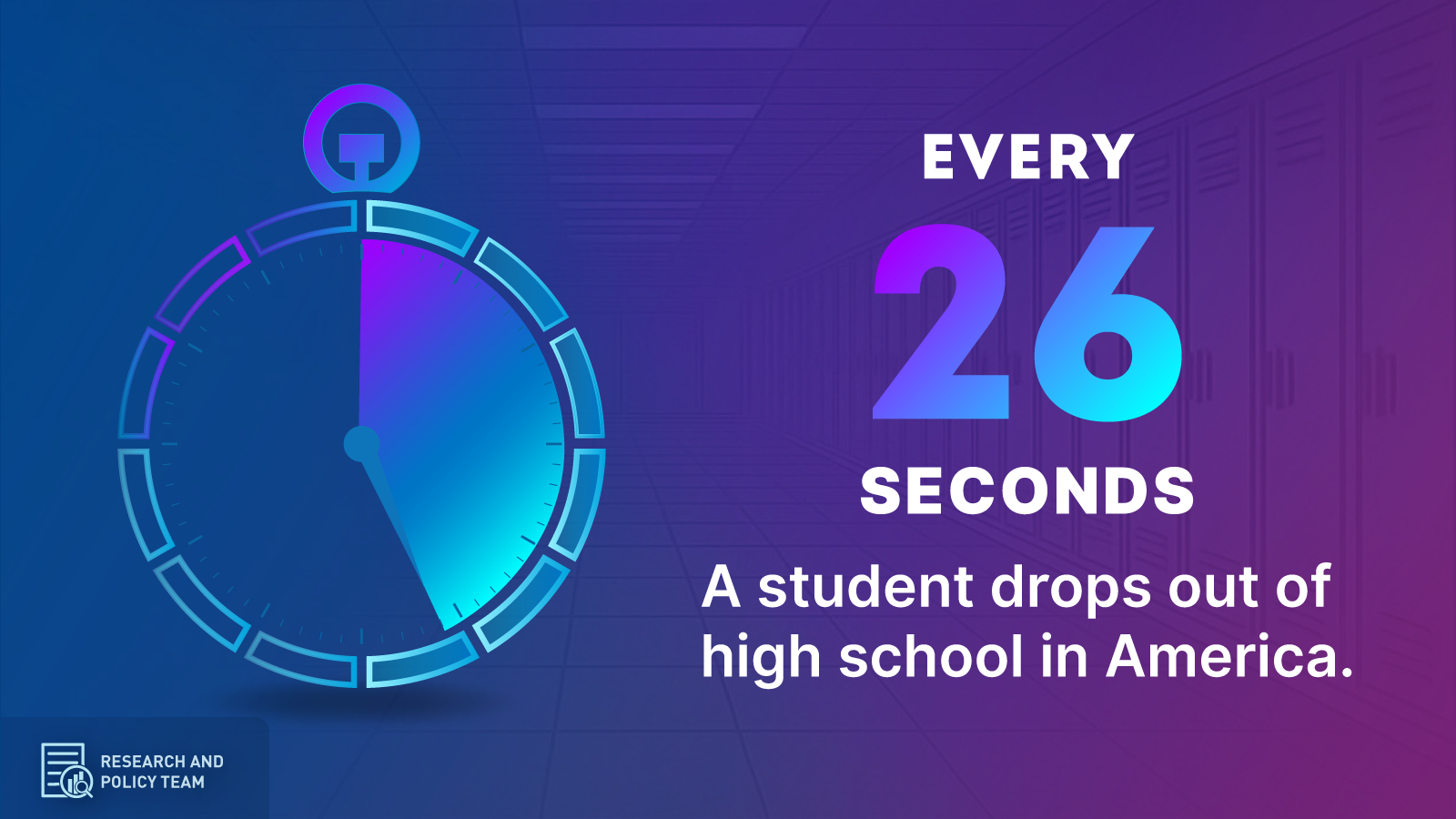
Every 26 seconds, a student drops out of high school in America. That’s more than 1.2 million students annually — roughly the population of Dallas, Texas — who leave the education system without a diploma. While the overall graduation rate has improved, progress has stalled since 2019, and the COVID-19 pandemic has threatened to reverse decades of gains.
At Acceleration Academies, we work daily with the students behind these statistics. They’re not numbers, they’re young people with potential, facing challenges that traditional schools weren’t designed to address.
The Inequality Behind the Average
The 86% national graduation rate masks profound disparities. When we disaggregate the data, a troubling picture emerges:
Students from low-income families drop out at twice the rate of their higher-income peers: 7.2% versus 3.9%. This isn’t just a statistic; it’s a systematic failure to serve our most vulnerable youth.
Special education students face a dropout rate of 9.7%; nearly double the national average. English learners experience a staggering 19.2% dropout rate, and students in juvenile justice settings face rates exceeding 32%.
Perhaps most concerning: these gaps aren’t shrinking. The status dropout rate has plateaued at 5.3% for the past three years after declining steadily from 7% in 2012. We’ve hit a wall, and without new approaches, millions more students will be left behind.
COVID’s Shadow
The pandemic didn’t create these disparities, it exposed and exacerbated them. By fall 2020, school districts across the country reported thousands of “missing” students who never logged on to remote learning or disappeared shortly after.
Chronic absenteeism is the strongest predictor of dropout, meaning we’re likely seeing just the beginning of COVID’s impact on graduation rates.
Large districts saw spikes in dropouts in the 15-20% ranges. For some students, economic hardship increased — teenagers took jobs as parents lost employment. Others had to care for younger siblings when schools and daycares closed. Many simply lost connection to school entirely.
Who Gets Left Behind
The students most likely to drop out share common characteristics, but they’re not defined by them:
- The over-age, under-credited student: At 18 years old with only 4 high school credits when they should have 20+
- The teen parent: Juggling childcare, often without support
- The working student: Contributing to family income out of necessity, not choice
- The highly mobile student: Moving frequently due to housing instability
- The justice-involved youth: Trying to re-enter education after incarceration
- The student with disabilities: Needing supports that scale as graduation approaches
Traditional high schools, designed for stable cohorts of students progressing through four sequential years, aren’t built to serve these populations. They need something different.
The Cost of Inaction
When we allow 1.2 million students to drop out annually, we’re not just failing individuals, we’re undermining our collective future. Each cohort of dropouts costs the U.S. economy an estimated $154 billion in lifetime earnings. That’s one year. Multiply it by decade after decade of inadequate responses, and the scale of loss becomes almost incomprehensible.
But economic cost is only part of the picture. High school dropouts face:
- Double the unemployment rate of graduates (12% vs. 6%)
- $366,000 less in lifetime earnings
- Significantly worse health outcomes and shorter life expectancy
- Half the civic participation rate of graduates
- Dramatically higher rates of incarceration
And perhaps most tragically, their children are more likely to drop out too, perpetuating cycles of limited opportunity across generations.
A Different Approach
At Acceleration Academies, we reject the idea that these outcomes are inevitable. Every day, we see students written off by traditional systems succeed when given the right environment: flexible scheduling that accommodates work and family responsibilities, wraparound supports addressing barriers beyond academics, personalized learning plans meeting students where they are, and caring adults who refuse to give up.
The question isn’t whether these students can succeed — it’s whether we’re willing to build systems designed for their success.
The Path Forward
Addressing America’s dropout crisis requires acknowledging uncomfortable truths:
First, the traditional four-year high school model doesn’t work for everyone, and forcing all students into that mold guarantees continued failure for the most vulnerable.
Second, COVID has created a new cohort of disconnected youth who need proactive re-engagement, not passive hope they’ll return on their own.
Third, the students with the highest dropout rates: low-income, special education, English learners, justice-involved, need targeted, specialized supports, not one-size-fits-all interventions.
Finally, we must measure success differently. If a 20-year-old who dropped out at 16 returns to school and graduates in two years, that’s a success story — even though they don’t appear in any four-year graduation rate.
Why This Matters Now
We’re at an inflection point. Graduation rates are stalling. COVID’s impact is still unfolding. Chronic absenteeism, the canary in the dropout coal mine, is at crisis levels in many districts. Meanwhile, the students most at risk of not completing high school are facing compounding challenges: economic uncertainty, mental health struggles, and weakened connections to school.
But we have solutions. Alternative education programs, dropout recovery initiatives, and re-engagement centers across the country are proving that with the right approaches, the vast majority of disconnected youth will return, persist, and graduate.
The question is whether policymakers, district leaders, and communities will invest in scaling what works before another million students disappear from our education system this year.
Every 26 seconds, we have a choice. We can continue systems that work for most while leaving the most vulnerable behind. Or we can build pathways that give every student — regardless of age, credits, circumstances, or challenges — a real shot at graduation.
At Acceleration Academies, we’ve made our choice. The results speak for themselves. Now it’s time for the rest of the education system to follow.
This is the first in a series exploring the economic and social benefits of re-engaging high school dropouts.
The Acceleration Academies’ Research & Policy Team is dedicated to advancing data-driven insights that help schools and communities better support opportunity for youth. Our team focuses on shining a light on barriers faced by students who have been disengaged from traditional high school pathways, elevating actionable data that helps schools re-engage learners, and driving evidence-based solutions for students who have been left behind.